Complete guide
How to run club recruitment: a complete guide for selective student organizations
The whole season in order, for clubs and professional fraternities that choose their members: what to decide first, how each stage works, and what to keep for next year.

Paul PassarelliFounder of Delibity. Former VP of Recruitment, Phi Gamma Nu (Cornell).
On this page
- What selective club recruitment is, and why it needs a process
- Before the season: rules, criteria and roles
- Stage 1: info sessions and events
- Stage 2: the application
- Stage 3: coffee chats
- Stage 4: interviews
- Stage 5: deliberations and the vote
- A sample four-week season
- After the season: decisions, rejections and handover
- Tools: from Forms and Sheets to one system
- Go deeper
- Questions chairs ask
- Sources
What selective club recruitment is, and why it needs a process
Selective club recruitment is the process a student organization uses to choose new members from more applicants than it has spots. Finance and consulting clubs, professional business fraternities, case teams and some performance groups all recruit this way. Open clubs, which take anyone who signs up, don't need most of this guide.
Open clubs, selective clubs and professional fraternities
Open clubs recruit by getting the word out: a table at the activities fair, flyers, a mailing list. Selective clubs also have to choose, so they add an application, conversations, interviews and a vote. Professional fraternities run the same stages and often call them rush, with candidates sometimes called PNMs (potential new members) and offers called bids.
The guide below uses the club words. The stages are the same either way.
How selective these clubs are
Selective clubs often take a small share of applicants. The Daily Bruin reported in 2023 that some UCLA organizations run as many as five recruitment rounds, and that Bruin Consulting's acceptance rate "hovers around 2% to 3%." EdSource's student journalists reported in 2025 that Stanford Consulting has a "sub-10% acceptance rate."
With numbers like these, every stage has to treat every candidate the same way. A club that rejects 90% of applicants needs to be able to explain how it decided.
What goes wrong without a process
Without a written process, recruitment lives in whatever tools last year's chair used. The Cornell Daily Sun described club volunteers "piecing together dozens of Google Forms and Google Sheets." A former president "had to manage and compile several different forms, spreadsheets and presentations."
The usual problems follow from that:
- Evaluations go missing, and nobody notices until delibs.
- Candidates go through different steps, so their records can't be compared.
- Too many events wear out members and candidates. The Sun found Cornell business clubs holding three to nine recruitment events in two weeks.
- Next year's chair starts from nothing.
Before the season: rules, criteria and roles
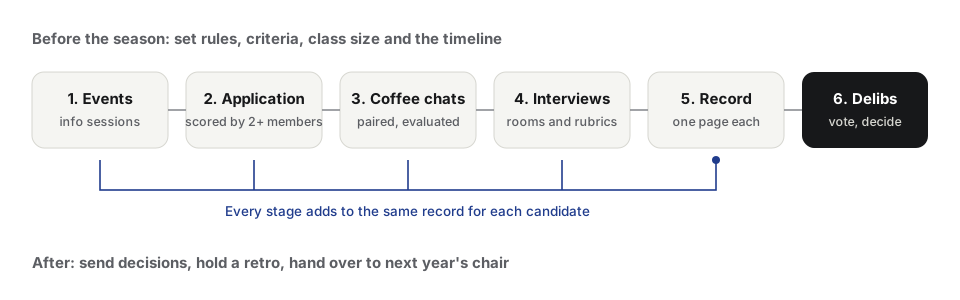
The most important recruiting work happens before anything opens. Decide the rules, the criteria and the class size in writing, and assign roles, before the first candidate shows up.
Decide class size and criteria first
Agree on how many new members the club wants, and what it is looking for, before you read a single application. Write criteria as things a member can observe: "explains a past project clearly" can be scored, while "good fit" can't. Set class size from last year's numbers, including how many people declined an offer. Final cuts and waitlists covers how many offers to send.
Officer roles: chair, admins and interviewers
Name one recruitment chair or VP of Recruitment who owns the timeline. Decide which officers are admins and which members interview. Admins see everything and run the season; interviewers see what they need to score. The recruitment chair's season checklist lists what the chair owns week by week.
Check your school's rules
Many schools now set rules for selective clubs, and some are strict. Penn's Wharton Council, for example, publishes rules for the clubs under it, including these:
| Rule | Effect on your season |
|---|---|
| One interview per applicant, 30 minutes at most | No multi-round interviews |
| Clubs may not request résumés | The application stands on its own questions |
| No group case interviews and no brainteasers | Interviews are individual and question-based |
| Interview questions standardized for every candidate | One question list per room, written in advance |
| At least one info session before taking applications | The info session is a required date |
Some schools go further. Emory's student organization office says membership "should be open and welcoming to all Emory University students," and asks groups that select members to submit a step-by-step description of their process. Read your school's student organization policies and its hazing policy before you set a date. If you are a chapter of a professional fraternity, read your national's rules too. The guide to fair club recruitment covers fairness and hazing risk in detail.
Stage 1: info sessions and events
Events let candidates meet the club and let the club see who is interested. Open the season with one or two info sessions and a small number of other events.
How many events to hold
Hold as few events as you need to explain the club and answer questions. Many applicants feel they have to attend most of a club's events, so every extra event costs candidates time, especially those with jobs or heavy course loads. Check every date against midterms and against other clubs' recruiting calendars if your school publishes one.
Tracking attendance without punishing people who can't come
Track attendance with a sign-in form or a QR code at the door. Then decide, in advance and in writing, whether attendance counts. Count it as a sign of interest, not a requirement: a candidate with a lab on Tuesday nights isn't less interested. Tell candidates the rule. The guides to info sessions, free QR check-in and whether attendance should count go deeper.
Stage 2: the application
The application is the first scored stage. Keep it short, score it on a rubric, and have more than one member read each one.
What to ask, and what not to ask
Ask two to four short questions that show how a candidate thinks: a project they're proud of, why this club, a short problem. Skip questions that repeat the résumé, and anything about family background, finances or other personal details that have nothing to do with the club's work. The guide to club application questions has examples by club type.
Splitting review across members
Give every application to at least two reviewers, and never to someone who knows the candidate well. Score each answer on the same three to five levels, with one example of a strong and a weak answer for each. Average the reviewers' scores, and flag big disagreements for a third read. How to review hundreds of applications fairly and the written application rubric cover the method.
Stage 3: coffee chats
Coffee chats are short one-on-one conversations between a candidate and a member. They let candidates ask real questions and let members see how a candidate talks about their interests.
Request form, pairing, evaluation, follow-up
Run coffee chats in four steps:
Open one request form. Collect name, school email, year, interests and availability.
Pair each request within 48 hours. Spread chats evenly across members and avoid pairing friends.
Evaluate every chat the same day. Members answer the same few questions about each chat.
Chase what's missing. Send each member a list of the chats they still owe, by name.
The guides to running coffee chats and the coffee chat evaluation form cover each step.
Stage 4: interviews
Interviews usually carry the most weight in a selective club's decision. Build the rubric before you schedule anything, train every interviewer on it, and score during the interview.
Rooms, rubrics and weights
Split interviews into rooms, each testing one thing: for example a behavioral room, a technical room and a case. Give each room three to five criteria with weights that add up to 100%, and a one-line description of a strong answer for each. Keep the same questions for every candidate in a room.
Scoring live and calibrating interviewers
Put two interviewers in each room when you can. Two scores on the same candidate catch the interviewer who grades everyone high or everyone low, and the second interviewer can take notes while the first asks questions. If you're short on members, keep two in the room that weighs most.
Score during or right after each interview, not at the end of the night. Scores written hours later drift toward whoever was most memorable. Before the season, have every interviewer score one practice candidate and compare, so a 4 out of 5 means the same thing in every room. The interview rubric template and how to run club interviews cover both.
Stage 5: deliberations and the vote
Deliberations, or delibs, are the meeting where members decide who gets in. Run them on one record per candidate, one candidate at a time, with the voting rules written down beforehand.
One candidate at a time, with a one-page record
Close every evaluation two days before delibs. Give the room one page per candidate with their application, chats, events and interview scores, in the same order every time. Discuss each candidate for a fixed time, using evidence from the record, then vote. How to run club deliberations walks through the whole meeting with an agenda and a script.
Recusal and admit, deny, abstain
Write the voting rules before anyone sees a name: who may vote, the quorum, the admit threshold, and how abstentions count. Members close to a candidate step out of that candidate's vote. Use a secret ballot and show only totals. Fraternity and professional fraternity voting covers national rules.
A sample four-week season
A four-week season works for many selective clubs: one week of events, one of applications and chats, one of interviews, and a final week for delibs and decisions. Planning starts six to eight weeks earlier. Stretch it if your school requires a later decision date, or compress it if your school sets one short window.
| Week | What happens | What the chair checks |
|---|---|---|
| 6 to 8 weeks before | Rules, criteria, class size, timeline, application built | Every date is on one calendar; the application works on a phone |
| Week 1 | Info sessions and events; application opens | Attendance is tracked; the recruiting page has the dates |
| Week 2 | Application closes; coffee chats paired and held; review assigned | Every chat request paired within 48 hours; every application has two reviewers |
| Week 3 | Interviews | Every candidate scored in every room |
| Week 4 | Evaluations close; delibs; decisions sent | No missing scores; every decision written down; every candidate told the same day |
The recruitment timeline template has this calendar as a spreadsheet you can edit.
After the season: decisions, rejections and handover
The season ends when every candidate has a decision and next year's chair has what they need. Both take less time if you plan them before the season starts.
Sending decisions kindly and on time
Send every decision at the time you announced, on the same day. Write rejections that thank the candidate, are specific about the next chance to apply, and don't give reasons you can't stand behind. The rejection email templates give wording you can adapt.
What to save for next year's chair
Save the rubric, the application, the timeline, the season's numbers and a short note on what to change. The numbers worth keeping are simple: applicants, coffee chats completed, candidates interviewed, offers sent and offers accepted. Next year's chair uses them to set class size and to see which stage lost the most candidates. Make the next chair an admin before you graduate. The guides to handing off recruitment and recruitment metrics cover what to keep.
Tools: from Forms and Sheets to one system
Many clubs start with Google Forms and Google Sheets, and for a small club with one round that is enough. The trouble starts when the season has several stages, because each stage gets its own form and sheet, and someone has to join them by hand before delibs.
| Stage | Forms, Sheets and slides | One recruitment tool |
|---|---|---|
| Events | A sign-in form per event | Check-in that adds to the candidate's record |
| Application | A form, scored in a shared sheet | Application and reviewer scores in one place |
| Coffee chats | A request form, pairing by hand, an evaluation form | Requests, pairing and evaluations linked to the candidate |
| Interviews | A scoring form or sheet per room | Rooms and weighted rubrics, scored live |
| Record | Copy everything into slides before delibs | One page per candidate, filled in as you go |
| Vote | Hands, or a poll | A ballot per candidate, with totals |
| Handover | Share the files and hope | Next year's chair copies last season |
Delibity is one recruitment tool built for this, and it is free for every student organization. Clubs on Delibity have run 163 interview sessions and submitted 21,384 interview evaluations. Delibity vs Google Forms and Sheets compares the two honestly, including when Forms is enough, and club recruitment software compares the other options.
Jordan Lee
Application82
Coffee chats2 completed
Events3 attended
Behavioral86
Technical79
Group case88
Interview overall84
How Delibity does this
One page per candidate
Each candidate's transcript holds their application, coffee chats, events attended and interview scores by room, so the room compares candidates on the same facts.
Members fill it in as the season runs. There's nothing to merge by hand before delibs.
See the whole seasonFrom automating emails to creating clean candidate profiles, Delibity played a critical role in making our recruitment process significantly faster and more efficient.
Go deeper
Every stage has its own guide:
- Club recruitment software and Delibity vs Google Forms and Sheets: choosing a tool
- How to review club applications fairly: the application stage
- How to run coffee chats: requests, pairing and evaluations
- Info session ideas: events and attendance
- Interview rubric template: rooms and weights
- How to run club deliberations: the meeting and the vote
- Fair club recruitment: bias, standard questions and hazing risk
- Recruitment chair responsibilities: the chair's season checklist
Questions chairs ask
How long does club recruitment usually take?
Plan for two to four weeks from the first info session to decisions. The Daily Bruin reported that TAMID's process at UCLA takes two weeks. Planning should start six to eight weeks before the first event.
How many rounds should club recruitment have?
Plan three to five stages: an application, coffee chats or events, one or two interview rounds, and deliberations. Fewer rounds respect candidates' time. Check your school's rules first, since some, like Wharton Council, allow only one interview per applicant.
Should coffee chats count toward decisions?
Use coffee chats to inform decisions, but don't weigh them heavily, because whether a chat happens depends on the member as much as the candidate. If chats count, every candidate needs the same chance to get one, and every chat needs an evaluation on the same questions.
How do clubs decide who gets in?
Selective clubs decide in deliberations. Members review one record per candidate, with application, chat, event and interview scores. They discuss each candidate for a fixed time, then vote admit, deny or abstain under rules written before the meeting.
What's the best tool for running club recruitment?
For a small club with one round, Google Forms and Sheets are enough. For a season with applications, coffee chats, interviews and a vote, a tool that keeps one record per candidate saves the most time. Delibity is built for this and is free for student organizations.
Sources
- Selective admissions processes for competitive clubs create challenges for Bruins, Daily Bruin, Oct. 19, 2023: up to five rounds; 2% to 3% acceptance; a two-week process (checked 2026-11-06) dailybruin.com
- College clubs becoming just as competitive as getting into college, EdSource California Student Journalism Corps, Jan. 7, 2025 (republished by the Piedmont Exedra): sub-10% acceptance at Stanford Consulting (checked 2026-11-06) piedmontexedra.com
- Students in Cornell Business Club Scene Reveal Misconduct, Intensive Recruitment Process, The Cornell Daily Sun, Feb. 7, 2024: three to nine events in two weeks (checked 2026-11-06) cornellsun.com
- Simplifying Club Deliberations: Paul Passarelli '27 Creates Delibity Platform, The Cornell Daily Sun, Jan. 12, 2026: clubs piecing together forms, sheets and presentations (checked 2026-11-06) cornellsun.com
- Recruitment Policies, Wharton Council: interview, résumé and info session rules (checked 2026-11-06) groups.wharton.upenn.edu
- Membership, Emory University Center for Student Leadership and Engagement: open membership and selection process descriptions (checked 2026-11-06) lead.emory.edu