Complete guide
How to run club deliberations: a step-by-step guide for e-boards
The whole night, from the rules you write a week before to the decisions you send after, for e-boards of selective clubs and professional fraternities.

Paul PassarelliFounder of Delibity. Former VP of Recruitment, Phi Gamma Nu (Cornell).
On this page
- What club deliberations are for
- Before delibs: prepare the record
- How to run the room
- How to vote on each candidate
- A facilitator script you can read aloud
- Hard cases
- After delibs: record, size the class, send decisions
- Running delibs in Delibity
- Printable delibs checklist
- Go deeper
- Questions chairs ask
- Sources
What club deliberations are for
Club deliberations, usually called delibs, are the meeting where members decide which candidates to admit after applications, coffee chats, events and interviews. The meeting turns weeks of separate impressions into one decision per candidate that the club can explain later.
The word is common across campuses. A University of Pennsylvania room booking titled "Delibs" describes the meeting as a time "to deliberate over who will be entering our newbie class." Fraternity rush works the same way: after the last night, members deliberate on everyone who visited.
Delibs go wrong in predictable ways:
- The meeting runs past midnight because nobody set a time per candidate.
- The loudest members swing votes, and quieter members stop speaking.
- People forget who a candidate was, so the discussion runs on memory and reputation.
- Nobody can explain a decision a week later, because nothing was written down.
Software sellers know this. PNM Pulse, a fraternity recruitment tool, leads its pitch with "Eliminate the shouting match." You don't need any software to fix most of it. You need a record, written rules and a clock.
If you are new to the vocabulary (delibs, bids, sub-pools, recusal), the club recruitment glossary defines each term. For the full season around this meeting, see how to run club recruitment.
Before delibs: prepare the record
Most of a good delibs night happens in the week before it. The goal is that nobody in the room has to rely on memory, and nobody can change the rules after seeing which candidates they affect.
Close every evaluation two days early
Set a deadline for every score and evaluation 48 hours before delibs. Coffee chat evaluations, interview scores and application reviews all count. Two days gives you time to chase the members who are behind.
Send each late member a list of exactly what they still owe, by candidate. "You still owe evaluations for Jordan Lee and Sam Ortiz" gets a faster response than "please finish your evals." The coffee chat tracker shows one way to keep that list.
A candidate with missing evaluations will be discussed on rumor. If an evaluation can't be finished, note that on the candidate's page so the room knows the gap exists.
Build one page per candidate
Give the room one page per candidate with everything the club knows, in the same order every time. Members then compare candidates on the same facts instead of on who spoke last.
A useful page has:
- name, year, major and the application answers that matter most
- the application score, if your club scores applications
- coffee chats: who met them and each member's short summary
- events attended
- interview scores by room, with each interviewer's notes
- anything the club has decided to weigh, such as a referral
Keep photos optional and consistent: show them for every candidate or for none. The one-page candidate transcript guide covers the layout in detail and why it beats a slideshow. Snowball Fundraising's recruitment guide says "voting can be almost impossible without a slideshow." A slideshow helps people remember faces, but it rarely shows the scores and notes next to the face.
Write the rules down before anyone sees a name
Agree on the rules in writing before the candidate list is final. Rules set after people know the names tend to bend toward a favorite. Delta Sigma Pi tells chapter officers to document their "criteria used in membership selection" and to follow the rules for eligibility and voting.
Decide these six things and share them with every voter:
| Rule | A common choice | Why it matters |
|---|---|---|
| Who may vote | Every active member who attended delibs | Stops absent members from voting on candidates they didn't hear discussed |
| Quorum | More than half of voting members present | A small room shouldn't decide the class |
| Admit threshold | Simple majority of admit and deny votes | A stricter club may use two-thirds |
| How abstentions count | They don't count toward the threshold | Abstaining should mean "I don't know," not "no" |
| Secret or open ballot | Secret, with totals shown | Members vote honestly when no one sees their choice |
| Recusal | Anyone close to a candidate steps out of that vote | Removes the friend vote and the grudge vote |
Two of those need a closer look.
On abstentions, Robert's Rules of Order says that when a rule asks for a majority vote, abstentions "have absolutely no effect on the outcome of the vote." If your rule instead says "a majority of members present," an abstention works like a no. Pick the one you mean and write it down.
On quorum, a quorum is the minimum number of voting members who must be present for the vote to count. If your club's constitution already sets one, use it.
Pre-sort candidates into three groups
Sort candidates into clear admits, clear denies and a discuss group before the meeting. Most of the room's time should go to the discuss group, where the decision is actually close.
A simple way to sort: rank by overall score, then have the recruitment chair and one other officer move anyone whose record doesn't match their score. Anyone in either clear group can be pulled into discussion by any member. That keeps the shortcut honest.
How to run the room
Running the room means three things: an agenda with time boxes, speaking rules everyone heard at the start, and recusal handled before each vote. The chair's job is to keep the meeting on those rules, not to argue for candidates.
Set the agenda and time boxes
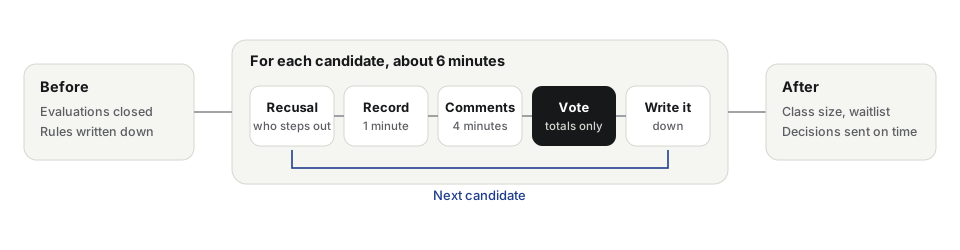
Put the agenda on the screen and give each segment a time. Six minutes per discussed candidate is a workable default: one minute to read the record, four minutes of comments, one minute to vote. With 25 candidates in the discuss group, that is two and a half hours.
| Time | Segment | Who leads | Rule |
|---|---|---|---|
| 0:00 | Open and read the rules | Chair | Read the written rules aloud; no names yet |
| 0:05 | Recusal check | Chair | Anyone who knows a candidate well says so now |
| 0:10 | Clear admits | Chair | Objections only; 2 minutes each |
| 0:30 | Discuss group, per candidate | Chair | Read the record (1 min), comments (4 min), vote (1 min) |
| 2:30 | Clear denies | Chair | Anyone may pull one into discussion |
| 2:45 | Class size and waitlist | President | Order the waitlist; set the final number |
| 3:00 | Close | Chair | Confirm decisions are written down; set when decisions go out |
Example timings for a club with 40 candidates and 25 in the discuss group. Change the per-candidate time, not the order.
Keep a visible timer. When time runs out, the chair calls the vote, even mid-sentence. A candidate who needs more time can be moved to the end of the list once, and only once.
Speaking rules that stop pile-ons
Read the speaking rules aloud at the start of every delibs, even if everyone has heard them. The point is that the chair can enforce them later without sounding personal.
Evidence only. A comment must point to something in the record or something the speaker saw: an answer in an interview, a conversation at a chat, how they treated people at an event.
Round-robin, not open floor. The chair calls on people in order. Anyone may pass.
No repeats. If a point was made, say "agree with Maya" and move on.
Short turns. About 45 seconds each. The chair cuts off speeches politely.
No hearsay. "I heard from a friend that…" isn't evidence. If it is serious, take it to the e-board outside the meeting.
Interviewers speak first. People who saw the candidate in a structured setting go before people with only general impressions.
PNM Pulse describes the old way as "shouting from the crowd or a manual 'raised hands' list that gets lost." A round-robin order fixes the same problem with no software at all.
Recusal: who steps out, and when
Recusal means a member doesn't vote on a candidate they are too close to judge fairly. Handle it before each candidate's discussion, not after the vote.
Ask members to recuse for a roommate, a close friend, a partner, a sibling, or someone they had a falling-out with. Have recused members leave the room or turn off their camera during that candidate's discussion and vote. If many members know a candidate, the chair can ask them to share facts first, then step out for the vote.
Recusal is covered in more depth, including anonymous ballots, in the guide to anonymous candidate voting.
How to vote on each candidate
Vote on one candidate at a time, right after that candidate's discussion. Each member chooses admit, deny or abstain. Show the room totals, never who voted which way.
Use the threshold you wrote down. These are the common ones:
| Rule | Admit when | Example with 9 admit, 3 deny, 1 abstain |
|---|---|---|
| Simple majority | More than half of admit plus deny votes | Admitted (9 of 12) |
| Two-thirds | At least two-thirds of admit plus deny votes | Admitted (9 of 12 is 75%) |
| Three-quarters | At least three-quarters of admit plus deny votes | Admitted (exactly 75%) |
| Unanimous | Every admit or deny vote is admit | Denied (3 deny votes) |
A secret ballot with totals shown is the usual choice for selective clubs. Open voting, by hand, sounds transparent but puts social pressure on newer members to follow the e-board.
Abstentions still count toward turnout and quorum. They just don't count toward the threshold. If everyone present abstains, the club has made no decision, and the candidate goes to the end of the list.
Voting customs differ in Greek-letter and professional fraternities, where national bylaws often set the rules. The guide to fraternity and professional fraternity voting covers those differences.
A facilitator script you can read aloud
A script keeps the chair neutral and the meeting on time. Read it word for word the first few times.
Opening: "Tonight we decide our new class. The rules are on the screen and were sent out last week. We discuss one candidate at a time, six minutes each. Comments use evidence from the record or something you saw yourself. Results show as totals only. Before each candidate, I'll ask if anyone needs to recuse."
Starting a candidate: "Next is Jordan Lee. Does anyone need to step out? Okay. Sam, please read the record."
Moving the discussion: "Thanks. Interviewers first. Then I'll go around the room. Please don't repeat a point; say you agree and pass."
When a comment goes off track: "Let's stick to what's in the record or what you saw. Anything else can go to the e-board after tonight."
Calling the vote: "Time. Please vote now: admit, deny or abstain."
Reading the result: "Nine admit, three deny, one abstain. Jordan is admitted under our majority rule. Next."
Closing: "That's every candidate. Decisions go out on Thursday at 6 PM. Please don't tell any candidate anything before then."
Hard cases
Most delibs nights hit at least one of these. Decide how you will handle them in advance, then point to the rule when it happens.
A split vote
A tie, or a vote that misses the threshold by one, gets one more minute of discussion and one revote, never more. If it is still split, the candidate is not admitted tonight and goes on the waitlist, if your club keeps one.
New information arrives mid-meeting
If someone raises a serious concern for the first time during delibs, pause that candidate. Move them to the end of the list. The e-board checks the concern privately before the club votes. Unverified claims shouldn't decide a candidate in a few minutes.
A member knows the candidate well
Ask the member to share facts during discussion, then step out for the vote. Their knowledge helps the room. Their vote, on a friend, doesn't.
The night runs long
If you are behind by more than 30 minutes, cut per-candidate time rather than skipping candidates. A candidate discussed at 2 AM by eight tired people gets a worse decision than one discussed at 9 PM by twenty. If your list is long, split delibs over two nights.
After delibs: record, size the class, send decisions
Before anyone leaves, the recruitment chair reads back the final list and saves it. A written record is the only way the club can explain a decision later, to a candidate, a new e-board or a national office.
Write down, for each candidate:
- the decision: admitted, waitlisted or not admitted
- the vote totals
- any recusals
- any rule exception and why
Then set the class size and order the waitlist. The guide to final cuts, waitlists and class size covers how many offers to send if you expect some admits to decline.
Send decisions at the time you announced, to everyone at once. Kind, specific rejection emails matter for your club's reputation next year; the rejection email templates give wording you can adapt. Delibity doesn't send decision emails for you: clubs send them from their own account.
Finally, hand the written rules and the record to next year's e-board. A club that writes down how it ran delibs doesn't start from zero every season.
Running delibs in Delibity
Delibity is free recruitment software for student organizations, and it started as a tool for this meeting. It holds the record before delibs and runs the vote during it.
The Cornell Daily Sun's profile of Delibity defines deliberations as where organizations "decide which new members to admit." Before building it, I ran recruitment as VP of Recruitment for Phi Gamma Nu, a business fraternity at Cornell.
In Delibity, the record is a transcript: each candidate's application, coffee chats, events and interview scores on one page. Candidate pools let you sort the class into groups such as clear admits and discuss, with bulk accept and reject.
Jordan Lee
Live results13 of 14 voted
Admit 9Deny 3Abstain 1
Admitted: 75% of the decided vote
Spring 2027 delibs · 1 recused from this candidate
How Delibity does this
One candidate at a time, totals only
The chair launches one candidate and every member's phone shows the same ballot: Admit, Deny or Abstain. Members with a conflict can be recused from that candidate.
Results show as totals, never who voted which way. The chair picks the rule (simple majority up to unanimous), a quorum, and whether totals show live, at close, or to admins only.
See the whole seasonDuring delibs, the chair stages candidates as an agenda and launches one at a time. Every member's phone shows the same ballot, and the chair can recuse a member from one candidate. The chair sets the threshold, a quorum, and whether totals show live, when the ballot closes, or to admins only. After the last vote, the new class screen shows who was admitted.
Our members loved the platform as it made it incredibly easy to identify the best new additions to our club.
Delibity doesn't decide anything for you. Members still score, discuss and vote; Delibity keeps the record in one place and counts the votes.
Printable delibs checklist
Print this, or copy it into your e-board's notes, the week before delibs.
Delibs checklist
- Evaluation deadline set 48 hours before delibs, and sent to every member
- Late members chased with a list of what each still owes
- One page per candidate, same layout for everyone
- Written rules sent to every voter: who votes, quorum, threshold, abstentions, ballot, recusal
- Candidates pre-sorted into clear admits, discuss and clear denies
- Agenda with time boxes on the screen
- Speaking rules read aloud at the start
- Recusal asked before every candidate
- One vote per candidate, totals shown, no names
- Every decision, vote total and recusal written down before anyone leaves
- Class size set and waitlist ordered
- Decision time announced, and a no-leaks reminder given
- Rules and record handed to next year's e-board
Go deeper
Each part of delibs has its own guide:
- Fraternity and professional fraternity voting: how voting customs and national rules differ
- Anonymous candidate voting: admit, deny, abstain and recusal in detail
- The one-page candidate transcript: what to show in delibs instead of a slideshow
- Final cuts and waitlists: class size, waitlists and sub-pools
- Fair club recruitment: reducing bias and standardizing questions
- Rejection email templates: telling candidates the decision
Questions chairs ask
How long should club deliberations take?
Plan for about six minutes per candidate you actually discuss, plus 30 minutes for rules, clear admits and clear denies. A club discussing 25 candidates needs about three hours. If your list is longer, split delibs across two nights rather than running past midnight.
Should delibs votes be anonymous?
Most selective clubs use a secret ballot and show only the totals. Members vote more honestly when nobody sees their choice, and newer members don't feel pressure to follow the e-board. Write the choice into your rules before delibs so nobody changes it mid-meeting.
Does an abstention count as a no vote?
It depends on your written rule. Under a "majority of votes cast" rule, an abstention has no effect on the result, which is what Robert's Rules describes. Under a "majority of members present" rule, an abstention works like a no. Decide which you mean before delibs.
Who should be allowed to vote in delibs?
Most clubs let every active member who attends delibs vote, so everyone voting heard the discussion. Members who are close to a candidate, such as a roommate or partner, should recuse from that candidate's discussion and vote.
What should we do when a delibs vote is tied?
Give the candidate one more minute of discussion and revote once. If the vote is still tied or short of the threshold, the candidate is not admitted that night and goes on the waitlist, if your club keeps one.
Sources
- Simplifying Club Deliberations: Paul Passarelli '27 Creates Delibity Platform, The Cornell Daily Sun: definition of deliberations; Paul's role at Phi Gamma Nu (checked 2026-11-06) cornellsun.com
- UPenn K-Beats Delibs, Penn College Houses: "delibs" in use for a club's admission meeting (checked 2026-11-06) collegehouses.upenn.edu
- Three-night frat rush kicks off Saturday night, The Dartmouth: members deliberate after the final rush night (checked 2026-11-06) thedartmouth.com
- PNM Pulse: "Eliminate the shouting match" and the speaking-queue problem (checked 2026-11-06) pnm-pulse-website.pages.dev
- 10 Awesome and Easy Sorority and Fraternity Recruitment Ideas, Snowball Fundraising: slideshow voting advice (checked 2026-11-06) snowballfundraising.com
- Collegiate Chapter Senior Vice President, Delta Sigma Pi: documenting selection criteria and voting rules (checked 2026-11-06) deltasigmapi.org
- Frequently Asked Questions, Question 6, Official Robert's Rules of Order website: how abstentions count (checked 2026-11-06) robertsrules.com
- Robert's Rules for Defining a Quorum, C. Alan Jennings, PRP: what a quorum is (checked 2026-11-06) dummies.com